Post-strike assessments by Nigerian military formations have confirmed that joint United States air operations inflicted extensive damage on a terrorist forest enclave in Tangaza Local Government Area of Sokoto State, while missile related debris from the strike was subsequently recovered across parts of Sokoto State, Kebbi State and Offa, Kwara State.
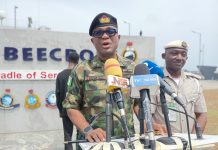
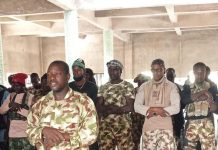
The assessment followed precision air operations conducted against hideouts in Bauni Forest, around the Waria and Alkassim axis, identified as operational bases used by terrorist elements. Ground exploitation began at first light on December 26th, 2025, led by troops of the Nigerian Army’s 8 Division, Sector 2 of Operation Fasan Yamma, working alongside the Combat Intelligence Brigade (CIB) VII.
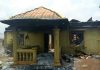
Findings from the post-airstrike exploitation confirmed the effectiveness of the operation. Forested areas around the impact points were completely burnt, with physical evidence indicating that the targeted elements were fully neutralized. Military verification further established that no civilian casualties were recorded during or after the strike.
Developments linked to the operation were recorded in neighbouring areas later that day.
Troops of 1 Brigade, Counter Terrorism Battalion 12, stationed at Forward Operating Base Jabo in Kebbi State, reported hearing an aircraft overhead, followed shortly by an explosion approximately one kilometre away. The unit immediately deployed patrols towards Kajiji town in Tambuwal Local Government Area of Sokoto State.
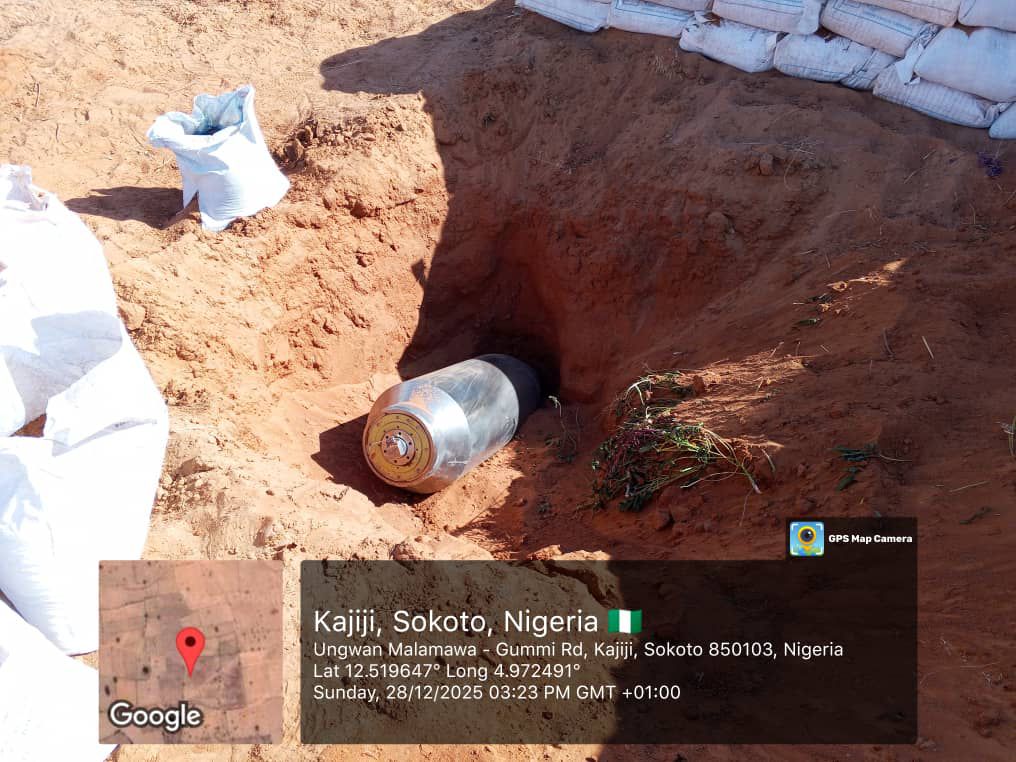
At the suspected impact site, soldiers recovered debris described as drone-like engine components, believed to be associated with the air operation. No human casualties were recorded at the location. Further patrols conducted later on December 26th led to the discovery of another object in Kajiji village, identified as a cylindrical canister suspected to have been released along the flight path of the missiles used during the Tangaza airstrike. The area was promptly secured pending technical evaluation by an Explosive Ordnance Disposal team.
Subsequent technical clarification by military engineers established that the recovered items were fuel boosters from Tomahawk missiles deployed during the operation. The boosters are designed to detach automatically shortly after launch once the missiles achieve stable flight.
Analysis showed that 16 missiles were fired during the strike, resulting in the discharge of 16 fuel boosters. As of the latest assessment, only three boosters have been recovered, with two located in Sokoto State and one in Offa.
Military sources explained that booster separation typically occurs several kilometres after launch and that projected landing zones are usually calculated prior to take-off. It was suggested that relevant authorities engage partner forces to obtain projected drop-off coordinates to enable faster recovery and improved safety planning.
Each booster reportedly weighs about 300 kilograms and is capable of penetrating soft ground to a depth of up to two metres.
While the overall risk is considered limited, uncontrolled landings may result in collateral damage, as reportedly observed in Offa.
Military authorities say investigations remain ongoing and that lessons from the post-airstrike assessment will be applied to strengthen coordination, safety protocols and operational synergy in future joint operations.