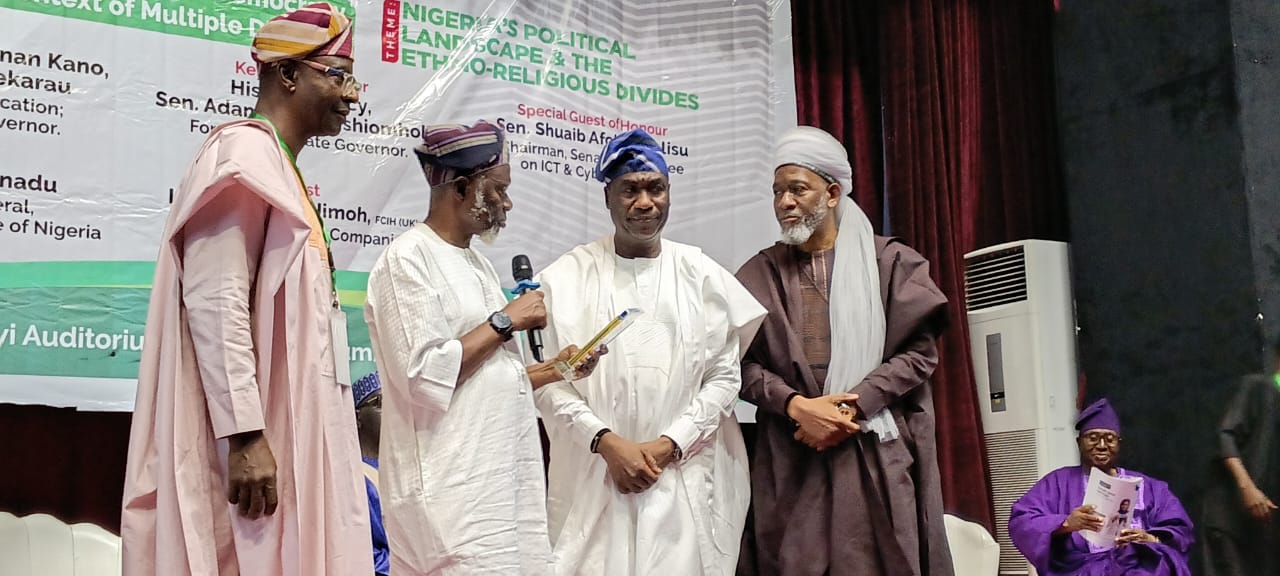
Lagos State Deputy Governor, Dr. Kadri Obafemi Hamzat, says Nigeria must make deliberate efforts to forge a stronger national identity that rises above ethnic, religious and cultural differences. Speaking at the 7th National Discourse on “Interrogating Nigeria’s Democracy in the Context of Multiple Diversity” at the J.F. Ade Ajayi Auditorium, UNILAG, Hamzat said the country’s political challenges partly stem from the failure to reconcile its cultural heritage with the Western democracy it practices. He noted that while ethnic and religious identities remain deeply rooted, they should not become instruments of division. “We must learn to accommodate our differences while promoting a common national identity,” he said, calling for greater religious tolerance and responsible family values.
Senator representing Edo West, Comrade Adams Oshiomhole, urged Nigerians to reject identity politics and choose leaders based on competence, ideas and values. He argued that diversity should be an asset for development, not a tool for mobilization, and that the real divide in Nigeria is between the deprived and those who have cornered wealth. “Nobody should be rewarded or punished on account of accident of birth,” Oshiomhole stated. Former Kano Governor, Mallam Ibrahim Shekarau, who chaired the event, also called for deeper understanding of religious teachings, saying both Islam and Christianity preach peace, justice and respect. He urged politicians to consult widely, uphold fairness and avoid turning politics into a do-or-die affair.
Earlier, National Amir of The Companions, Imam Noreen Jimoh, said the discourse was convened to examine how Nigeria’s democracy can manage its vast diversity. Guest lecturer, Prof. Liasu Adele Jinadu, said ethnicity has been exploited by political elites since colonial times to build patronage and weaken state institutions. He called for a system that prioritizes citizenship, transparency and human development over ethnic interests, in line with the 1999 Constitution. “Our goal should be a democracy in which citizenship is stronger than primordial identity,” Imam Jimoh said. “Not because ethnicity, religion or culture should disappear, but because our Nigerian identity must provide the larger umbrella under which all these identities can peacefully coexist.”